Research Interests
My main research interest has been Vladimir Nabokov. My dissertation was about the reception of the classical tradition in Russian interwar émigré literature and the uses of Greek and Roman sexualities in the creation of modernist high art, with a specific focus on Nabokov.
I am fascinated by the ways in which traditions subvert themselves in order to grow and expand. Nabokov’s legacy interests me from from the standpoint of adaptability and reparative attitudes to loss of country, culture, and language.
My current research interests include: creative writing, queer theory, reparative knowledge and queer(ed) pedagogy, ethics of power, decolonization of Russian studies, Russian émigré and immigrant culture, classical antiquity, intercultural competence and communication ethics, private and social aspects of queerness and gender-non-conformity, literary genealogies, comparative literature, contemporary Russian art and media.
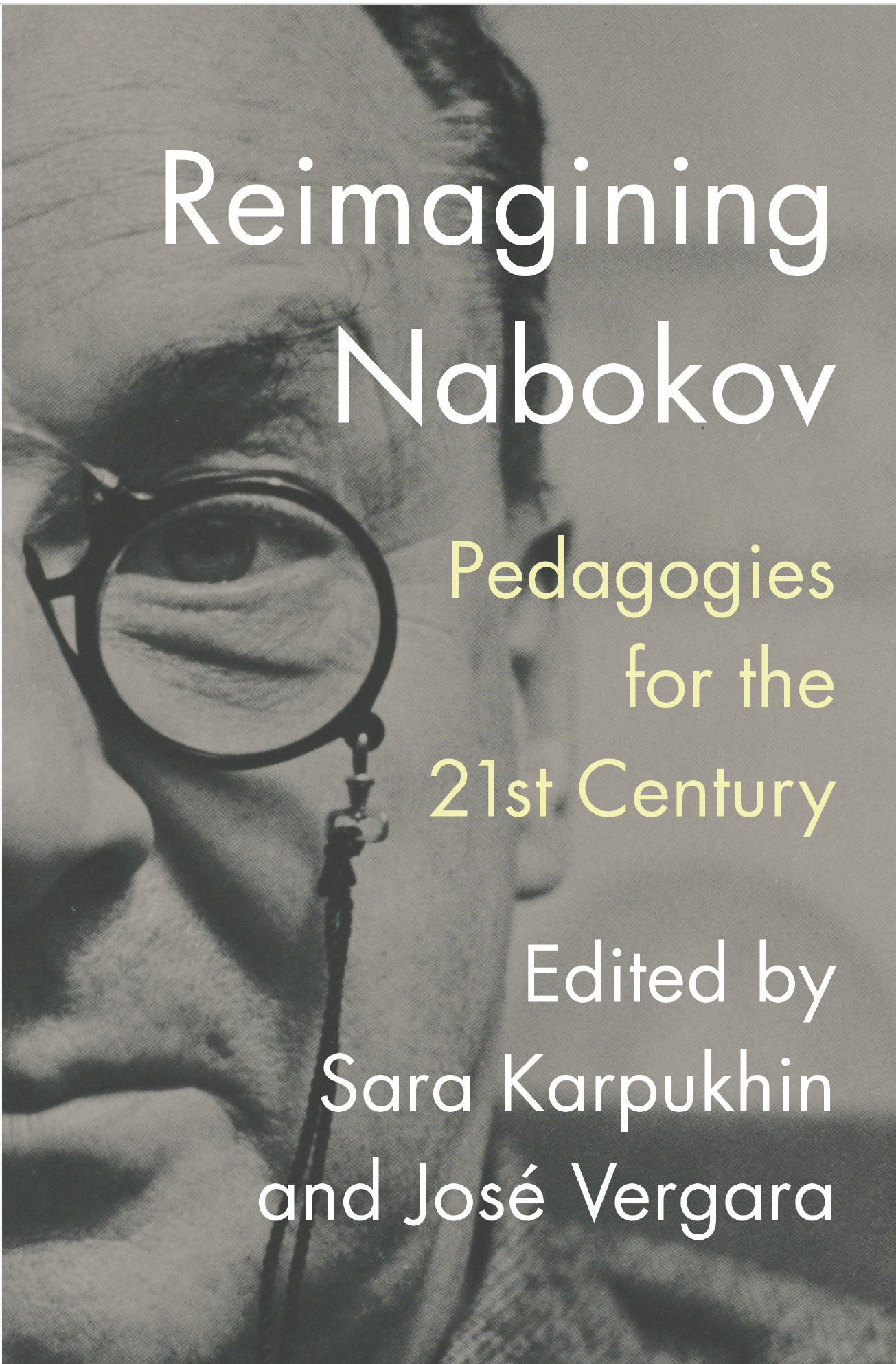
I am a co-editor, with José Vergara, of a collective volume Reimagining Nabokov: Pedagogies for the 21st Century (Open Access, Amherst College Press, 2022). As a contributor to the volume, I write about reparative knowledge and the role of academic discussion and creative assignments in intercommunal repair.
My article about Nabokov’s theory of literary evolution (Slavic and Eastern European Journal 67.1, Spring 2023, pp. 46-65) deals with the writer’s life-long strategies of “conceptual survival” in relation to such ideological environments as Russian Formalism, Marxism, and academic literary studies in the U.S.
In an article on Nabokov’s early experiments with Russian hexameters (International Journal of the Classical Tradition 27.1, March 2020, pp. 89-111), I analyze his published and unpublished hexametric poems and argue that as a young poet Nabokov was seeking ways to individualize the classical tradition.
I am currently working on a project provisionally titled Queer Nabokov, where I look at Nabokov’s vocabulary of difference, in English and in Russian. The Slavic Literature Pod published my short introduction into the topic, based on a conference presentation I did at the Hidden Nabokov conference at Wellesley College in 2022. My article on teaching Nabokov queerly is forthcoming in 2026.
I described my course Queer Russians in the chapter “Queer Russians in the American College Classroom” in the volume Diversity and Decolonization in Teaching Russian Studies, edited by Thomas Jesús Garza and Rachel Stauffer (Cham, Switzerland: Palgrave Macmillan, 2025), pp. 179-192.
Some of my publications can be found on my page on Academia.edu. My Russian crib of Sappho’s Fragment 31, with my preface and short commentary, has been the most popular scholarly text I have published there.
In graduate school, between 2009 and 2015, I kept a blog where I published short excerpts from my daily Greek and Latin readings with my Russian translation and commentary (and an occasional Russian poem).
Teaching
In Fall 2026, I am teaching a course on the Russian and American novels of Vladimir Nabokov (The Defense, Despair, Invitation to a Beheading, Pnin, Lolita, and Pale Fire), Fourth-Year Russian, and the History of Russian Culture.